
What is redeployable CCTV? The complete buyer's guide
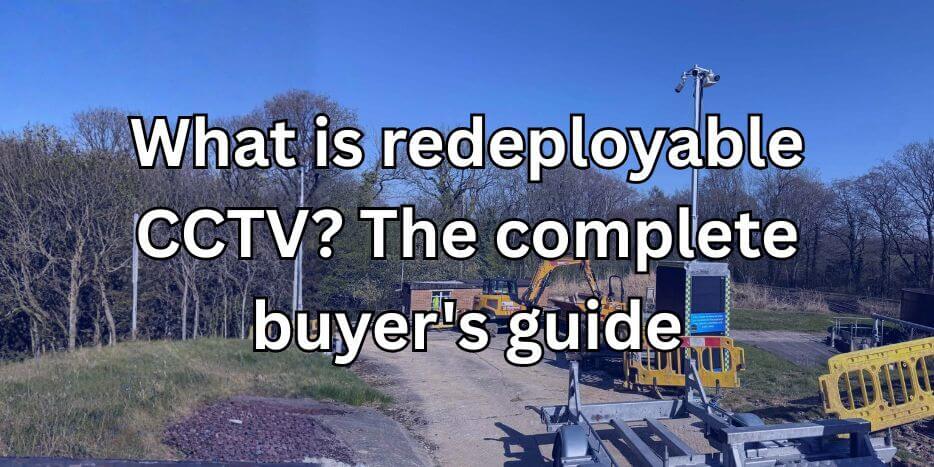
Your phone rings at 7:15 am. It's your client. There's been a break-in at the construction site overnight - power tools gone, plant cabin ransacked. And the CCTV tower? "The footage stops on Tuesday," they tell you. "Did you know it wasn't recording?"
You didn't. And now you're explaining to a very unhappy client why the temporary security you recommended... wasn't actually working.
That scenario plays out on sites across the UK every week. Not because installers don't care. Because the redeployable CCTV market is confusing, poorly defined, and almost entirely explained by manufacturers who have a vested interest in what you buy.
This guide exists to change that.
There is no official UK industry definition of "redeployable CCTV." No BSIA standard, no NSI guidance document, no Surveillance Camera Commissioner publication. What exists is a fast-growing market of products - ranging from a £200 pole-mounted camera to a £30,000+ autonomous tower - all called by different names depending on who's selling them. Installers are expected to navigate this, advise clients, and stake their reputation on equipment they may never have properly compared.
So let's fix that. Here's what you actually need to know.
What is Redeployable CCTV?
Redeployable CCTV is the broad term for any surveillance system designed to be deployed temporarily and relocated without permanent infrastructure. No groundworks. No mains connection required. No planning permission for installation. The camera arrives, goes live, and when the need changes, it moves.
The terminology is genuinely inconsistent across the industry. Local authorities and police forces predominantly say "redeployable CCTV" or "RDC." Construction firms say "CCTV tower" or "rapid deployment CCTV tower." Events and hire companies say "temporary CCTV." They're all describing variations of the same product category - but the variations matter enormously.
What unites them: no permanent infrastructure required, designed for relocation, and some form of autonomous power or connectivity. What divides them: capability, power resilience, build quality, and whether they'll still be working when your client needs the footage.
Six Product Types - And Why They're Not Interchangeable
The redeployable CCTV market contains six distinct product types. Understanding where each one sits - and where each one fails - is the foundation of giving your clients good advice.
1. Pole-Mounted Redeployable Dome Cameras
The entry point of the category. Compact all-in-one units - PTZ camera, local recording, battery backup, 4G transmission - mounted to existing street furniture: lampposts, telegraph poles, building walls. Deployment time under 20 minutes. Ideal for fly-tipping hotspots, ASB corridors, or locations where a lamppost is already there, and the problem is defined and short-term.
The limitation is built into the name. No lamppost or suitable mounting point? No camera. These units are infrastructure-dependent. They're not a solution for construction sites, vacant land, rural locations, or anywhere without the right existing fixture.
2. Standalone Autonomous CCTV Towers
The premium tier. Freestanding portable towers on telescopic masts - typically 6 to 7 metres - with multiple cameras providing near-360° coverage, integrated power, 4G connectivity, onboard recording, and full ARC monitoring capability. Zero existing infrastructure required. The tower is the infrastructure.
This is the product category that matters most for installers working on construction sites, vacant properties, infrastructure projects, and events. The capability spread within this tier is enormous - from cheap solar-only units that go dark in November to fully autonomous systems with methanol fuel cell backup running for six months without intervention.
More on that distinction shortly. It's the most important buying decision in this entire guide.
3. Trailer-Mounted Units
Towable surveillance platforms on trailers - solar panels, telescopic mast, self-contained power. The advantage is repositioning speed: tow to a new location and redeploy without lifting equipment. The disadvantage is the need for flat, accessible ground and the vulnerability of a trailer to theft and tipping on poorly managed sites.
4. Vehicle-Mounted Systems
Modified vehicles with roof-mounted cameras and internal monitoring. Used primarily for parking enforcement and mobile ASB patrols. Treated as a separate procurement category in most UK public sector tender documentation - not typically what your clients mean when they ask about temporary CCTV for a site.
5. Wireless Perimeter Detection Camera Systems
An adjacent category that frequently comes up alongside tower discussions. Autonomous wireless units combining PIR detection with triggered image capture - no power, no Wi-Fi, no cabling, deployed in minutes per device. Battery life up to 400 days. Excellent for perimeter protection on large or irregular sites.
The important distinction: these systems provide triggered images, not continuous video. That limits their evidential value in some applications and means they don't meet BS 8418:2021 requirements for detector-activated video surveillance systems with ARC monitoring. They complement tower deployments; they don't replace them where continuous recording and remote monitoring are required.
6. Covert Rapid Deployment Cameras
Smaller, lower-visibility units designed for evidence gathering rather than deterrence. Useful for targeted operations - persistent fly-tipping, suspected drug activity, and housing association applications. A niche product within the category, but worth knowing about for clients whose brief is intelligence-gathering rather than overt deterrence.
The Technical Hierarchy: Where Cheap Towers Actually Fall Down
Within the autonomous tower category - the one your clients are most likely asking about - there are four power configurations. The difference between them isn't a matter of preference. It's the difference between a tower that works in February and one that doesn't.
London receives roughly nine times less solar energy in December than in July. That's not a worst-case figure. That's the actual measured difference between peak and winter solar irradiance in the south of England - and it's worse further north. A tower optimised for summer solar performance will lose meaningful operating capacity through autumn and won't reliably charge its batteries through winter at all.
Here's how the four configurations stack up, honestly:
| Power Configuration | Summer Performance | Winter Performance | All-Weather Reliability |
|---|---|---|---|
| Solar only | Adequate in good conditions | Unreliable. Battery depletion common. Recording stops. | ❌ Not reliable year-round |
| Mains + battery backup | Excellent where mains are available | Excellent where mains are available | ✅ Reliable - but requires infrastructure |
| Diesel generator | Reliable but noisy, emissions-heavy, fuel theft risk | Reliable but significant maintenance overhead | ⚠️ Being phased out across most sectors |
| Solar + methanol fuel cell + battery backup | Reliable | Fully reliable. A fuel cell operates independently of solar. | ✅ Designed for all-weather, autonomous operation |
The solar-only failure mode isn't theoretical. Multiple UK suppliers openly reference battery replacement services and winter performance limitations in their own product documentation. One widely deployed tower type is known to remotely switch load off during daylight hours in winter, reducing detection capability precisely when shorter days and longer nights mean your client's site is most vulnerable.
The REG Army at CCTV Hire & Sales uses Dual Power Plus - solar combined with methanol fuel cells, providing six months of runtime plus a five-week backup reserve. When REG105 was deployed under a viaduct in Sheffield for an overnight carriageway job, solar wasn't an option at all. The site was in permanent shade. Dual Power Plus ran without interruption. That's not a marketing claim - it's a documented deployment. The difference between a tower that works in awkward locations and one that doesn't is the power system.
No one wants to bet their reputation on mediocre CCTV Tower systems that rely on solar power and hope for the best. Right?
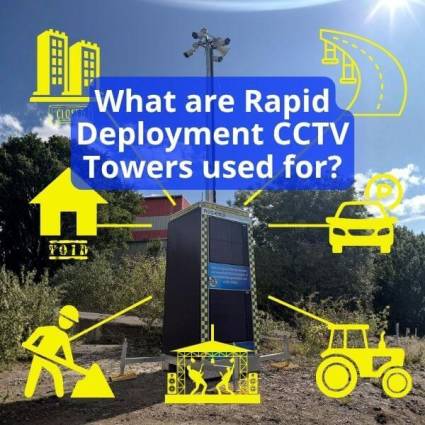
Where Redeployable CCTV is Used - and What Each Sector Needs
The four main sectors where your clients are likely to ask for redeployable CCTV each have different requirements, different threat profiles, and different standards implications.
Construction Sites
The largest single market for redeployable CCTV towers. According to BauWatch's 2025 Crime Report - a survey of 500 UK construction professionals - 67% reported an increase in construction site crime in the past 12 months, and 31% of UK construction sites now deploy CCTV towers. The most stolen items are power tools, copper, and cables. Criminal tactics are increasingly sophisticated: 28% of respondents reported criminals hacking security systems, and 26% observed drone reconnaissance being used ahead of a theft.
The widely cited industry figure of £800 million in annual construction theft losses dates from pre-2023 research. Whether that precise number holds today, the direction is undeniable: Direct Line Business Insurance recorded 44,514 tool theft incidents in 2023 alone, worth £98 million in reported losses. That's a theft every 12 minutes - and those are only the reported ones.
Construction site deployments need towers that can cover large footprints (360° camera coverage, typically 4 cameras minimum), operate through winter without power interruption, and meet BS 8418:2021 requirements if ARC monitoring and police URN response are part of the brief.
Vacant and Void Properties
England has 265,061 long-term vacant properties as of 2024 - the highest figure in over a decade. Empty buildings attract squatters, fly-tippers, metal thieves, and arsonists. Home Office research has identified an average of 60 fires per day in or next to vacant and derelict buildings. For your facility manager and property management clients, vacant property security can run for months or even years, which means power resilience and sustained uptime matter even more than in a short construction phase.
The failure mode on vacant properties is slow and insidious: a solar tower quietly stops recording four days before a break-in. No one notices. The copper gets stripped. Your client files an insurance claim. And then discovers there's no footage to support it. The insurer wants evidence of active security - time-stamped footage, monitoring logs, and documented check-ins. Mediocre towers don't provide that. Premium by Design towers do.
Infrastructure Projects
Rail, roads, utilities, and energy sites share a common challenge: remote locations with no permanent infrastructure and extended project timescales. Railway cable theft caused 101 incidents in 2023/24, generating over 55,000 minutes of train delays. Rising copper prices - up over 50% in a single year to around £5,000 per tonne by mid-2024 - have intensified the theft incentive on energy and utilities sites.
Infrastructure deployments often involve linear sites (a stretch of rail line, a highway carriageway) where multiple towers need to cover a corridor rather than a perimeter. The REG Army's rapid deployment capability - live on site tomorrow or the next working day - makes it viable to respond to a new theft hotspot on a live rail project without weeks of procurement delay.
Events and Temporary Venues
The events sector is undergoing a significant compliance shift. The Terrorism (Protection of Premises) Act 2025 - known as Martyn's Law - received Royal Assent in April 2025 and is expected to come into force no earlier than April 2027. Events with 800 or more expected attendees will face Enhanced Tier requirements, which include "appropriate public protection measures" to reduce vulnerability to terrorist attack. Official GOV.UK guidance lists CCTV explicitly as an example of a qualifying monitoring measure.
For outdoor events, temporary venues, and seasonal sites - festivals, markets, sporting events - there is no fixed CCTV infrastructure to point to. Redeployable towers are the obvious, practical compliance answer for installers advising event organisers. We cover Martyn's Law in detail in a separate article in this series.
The Regulatory Obligations Your Clients Need to Know About
Redeployable CCTV isn't compliance-free just because it's temporary. Your clients' obligations travel with the camera.
BS 8418:2021 is the British Standard covering detector-activated video surveillance systems - the code of practice that governs towers with PIR or video-analytics activation, ARC monitoring, and audio challenge capability. Compliance with BS 8418:2021, installed by an NSI or SSAIB-certified company, is a prerequisite for obtaining a police Unique Reference Number (URN) through BS 8484. Without a URN, there is no priority police response to alarm activations. If your clients want monitored CCTV with police response capability, this standard matters - and it applies equally to temporary towers.
UK GDPR applies to every CCTV system that captures images of identifiable individuals - including temporary towers. Your clients are data controllers the moment the camera goes live. Key obligations include: identifying a lawful basis for processing (legitimate interests is the most common for commercial operators); completing a Data Protection Impact Assessment (DPIA), which the ICO states is required "in most cases" for surveillance systems; displaying appropriate signage informing individuals they are being recorded; and not retaining footage longer than necessary. The widely used 30-day retention period is an industry standard - there is no legally mandated minimum or maximum period under UK GDPR. Crucially, when the tower moves to a new location, new signage is required for that location. Compliance doesn't carry over automatically.
The ICO's Video Surveillance Guidance is the authoritative reference document for commercial operators and is advisory rather than legally binding - though failure to follow it can be used as evidence in enforcement proceedings.
Five Questions to Ask Any Redeployable CCTV Supplier
The research behind this guide identified a clear pattern: the redeployable CCTV market is almost entirely explained by manufacturer content. Every buyer's guide currently ranking on page 1 is written by a supplier with a product to sell. That's why this framework exists - to give you questions that cut through the marketing and surface the answers that protect your reputation.
1. What is the power configuration, and what happens in December?
Ask specifically about winter performance. Solar-only suppliers will often reference battery replacement schedules or load-shedding programmes. Any honest answer that includes phrases like "we remotely manage load in winter" means the tower is not fully operational in winter. Ask for the minimum guaranteed operating hours per day during November to February.
2. What is the uptime commitment, and how is it substantiated?
"Reliable" is a marketing word. "99% connectivity uptime, proven across 550,000+ operational hours" is a substantiated claim. Ask for the specific metric and the evidence base behind it. The REG Army has delivered 550,000+ operational hours across 250+ sites - that's the kind of answer that matters.
3. Is the system BS 8418:2021 compliant, and does ARC monitoring include a police URN?
If your client needs police response capability, this is non-negotiable. BS 8418:2021 compliance via an NSI or SSAIB-certified installer is the prerequisite. Ask which ARC is used, whether it holds the relevant certification, and what the URN provision process looks like for a new deployment.
4. What does remote monitoring actually cover, and what triggers a check?
Some suppliers check towers when a client calls to complain. Others conduct proactive weekly check-ins and monitor power levels, connectivity, camera function, and storage capacity automatically. The difference matters when a fault develops on day three of a two-week hire and no one notices until the client does. Ask specifically: what is checked, how often, and who contacts whom when something is wrong?
5. What is the deployment guarantee, and what happens if it's broken?
"Next working day" means nothing without a consequence for failure. CCTV Hire & Sales backs rapid deployment, 99% uptime, and zero power outage with the No-Brainer Promise* - if any of those three commitments are broken, you get six months of hire free. That's the standard a genuine commitment looks like. Ask every supplier: what is your guarantee, and what do I get if you break it?
"I tried another tower supplier before discovering Phil - it was a complete waste of time. I waited 12 days for an email response after countless follow-up calls. In contrast, Phil at CCTV Hire & Sales was professional, honest and involved every step of the way. I was so impressed with the first tower that I bought a second one within a month!"
- Stephen Prout, CCS Security
The REG Army: Where Premium by Design Meets the Real World
At the premium end of the autonomous tower category sit systems built to permanent-grade standards for temporary sites. That's the positioning CCTV Hire & Sales was founded on - and the founding story is instructive.
Phil Clarke built the REG Army because mediocre towers were letting installers down in four predictable ways: recordings stopped because storage ran out; towers went dark because solar panels failed; units got kicked over by vandals; and support disappeared the moment the tower left the yard. Phil knew it didn't have to be like that.
The REG Army of 100+ towers is built to handle the same power-hungry equipment you'd specify on a permanent site. Dual Power Plus - solar, methanol fuel cells with six months runtime, plus five weeks of backup - means zero power outage. Next-gen Dual Vision thermal cameras detect threats at 80 metres, through fog and darkness. Every tower ships with BS 8484 ARC monitoring, two-way audio challenge, 24/7 onboard NVR recording with a minimum 30-day retention period, and TRU wind-certified chassis weighing over 500kg.
And it arrives tomorrow. Or the next working day. Commissioned and detecting before your client's site manager arrives for their morning walkround.
When the Police asked where their security was at a construction site in South Yorkshire - the contractor had removed their cabins and the permanent system wasn't installed - REG66 was on site and operational in under two hours from the first call. That's not a hypothetical. That's how the REG Army works.
Isn't it time to rethink your temporary security expectations?
Call us on 0114 321 1785 - there's every chance we can help you today. Or explore the full REG Army hire range and towers available for purchase on our website.
Who else backs their promise with six months free if they break it?
* The No-Brainer Promise applies to 12-month or longer hire contracts. The six-month free hire credit is issued where CCTV Hire & Sales is in verified breach of rapid deployment, 99% connectivity uptime, or zero power outage commitments. Reasonable terms and conditions apply. Acts of God and similar events render the Promise void.

This blog post is provided for general information only. It is not a site survey, technical specification, security assessment or professional recommendation for your specific site or your client's site. You should not rely on it as the basis for taking or refraining from any action.
Call CCTV Hire & Sales on 0114 321 1785 to speak to one of our team for specialist advice.